It’s His final charge to the disciples, climactically summarizing His entire ministry and pointing to what the disciples must now do. A blog is not the place to review the core content of the Great Commission, so I’ll say it quickly in graphic form.
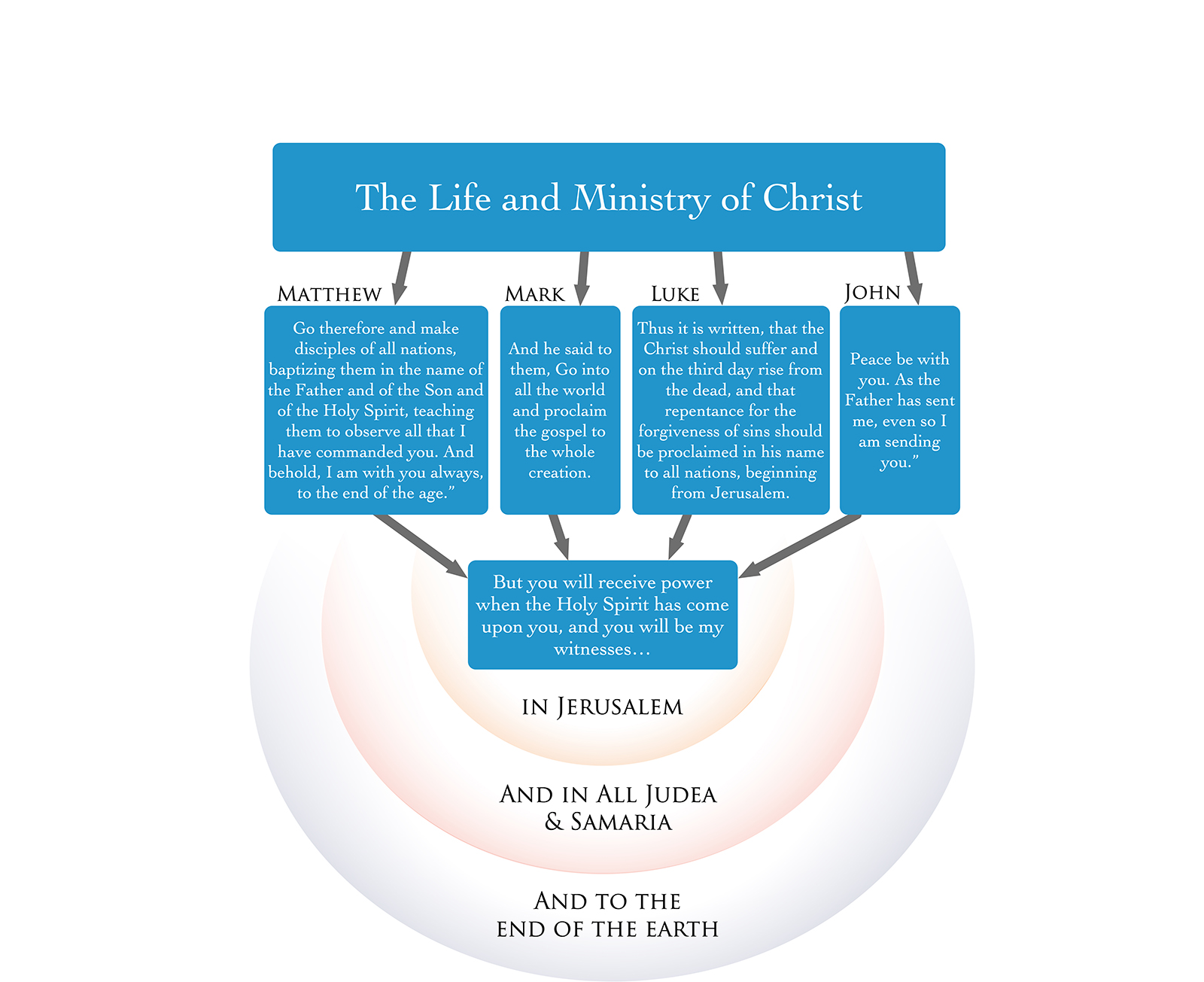
Two Errors
We can go wrong in our thinking in two opposite directions. On the one hand, we might assume the Great Commission is all about evangelism. From there we try to accumulate quick professions without “wasting time” to fully equip the new converts. This can even take ethnocentric forms, such as “people in the nation of Fictitious-stan are so simple, they don’t need complicated training in theology.” But Jesus’ words are quite specific—“go and make disciples…. teach them to observe everything I have commanded you” (see Matthew 28:19–20). This is not the sort of thing one can accomplish while waiting for a stoplight.
The opposite error assumes that we know what discipleship is and adds barnacles of cultural meaning. “Discipleship means two guys sitting in a coffee shop ‘hanging out’; it must be casual and conversational; it must be one-on-one; it’s not about what you say but ‘who you embody’” and so on. Remember, though, that discipleship is fundamentally defined by what Jesus did. He conversed directly with His disciples, He lived with them, preached to them, sent them out to do ministry on their own, and then reviewed what happened. There are lots of ways to disciple people, including evangelism itself. At its core, discipleship means anything you do to bring a person from being at enmity with God to being a flourishing believer.
A Core That Must Remain Unchanged
And “everything I have commanded you” is normative for the entire world. The culture, struggles, and needs of individual countries vary widely. What seems sensible in one place sounds absurd in another. Jesus issues one body of doctrine and directives, making that authoritative for every culture on the planet. Contextualization and cultural translation are real. But we don’t have to reinvent the fundamental message for each place. In fact, there is a core that must remain unchanged in every cultural expression of Christianity, enough so that believers in Amsterdam, Qatar, and Jakarta can all recognizably obey what Christ demanded.
But here we encounter the challenge. Making disciples cannot mean affirming them in their existing culture since that would involve no actual change. Nor can it mean winning them to our culture since that would confuse Jesus’ teaching with Americanism—two very different things. Nor can it mean making a few tweaks on the surface, such as “sit in my church building for two hours every Sunday, and stay away from women you aren’t married to, and that will do.” We dare not reduce the richness of Jesus’ ministry and the entire New Testament to a mere series of bullet points and checkboxes.
Christ's Instructions Invade and Correct Every Cultural Framework
That means that Christ’s instructions invade and correct every cultural framework, calling Americans, Turks, Filipinos, and the citizens of “Fictitious-stan” to repent and turn their patterns of living upside-down. Mere external weirdness will not be enough. Discipleship cannot be bought in a clothing store, paid for in a barbershop, or uploaded for a new profile picture and simply left there. Remember—culture goes to the very core of our values, thinking, and assumptions, and includes all of life. Jesus calls us rather to reject the world—the entire blue and green round thing that you live on. In its place, seek first the kingdom of God.
Unsurprisingly, this turns out to be a bit of a challenge. The first barrier every missionary faces is his own self—learning to be a faithful disciple of Jesus by repudiating our own cultural brokenness. From there, we struggle to transcend the culture gap. Those we live among can see that we are foreigners; naturally, they assume that we are merely brandishing our own upbringing rather than embracing the authoritative dictates of the King of the universe.
Hope for the Impossible Task
But there is still hope for the seemingly and truly impossible task because ultimately the mission is His, not ours. We speak merely as representatives—as ambassadors of Christ. We can make disciples because our victorious King has now received “all power… in heaven and in earth.” Most significantly, we never go alone. The closing words of the Great Commission are also our hope and final assurance: “and, lo, I am with you always, even unto the end of the world. Amen.”